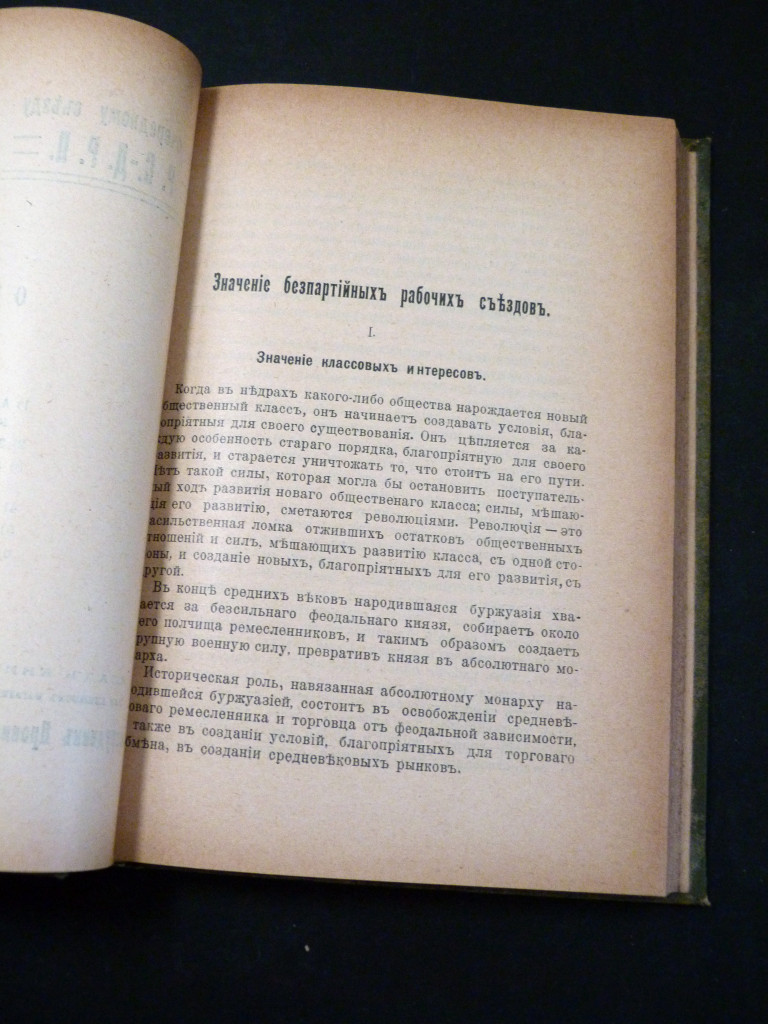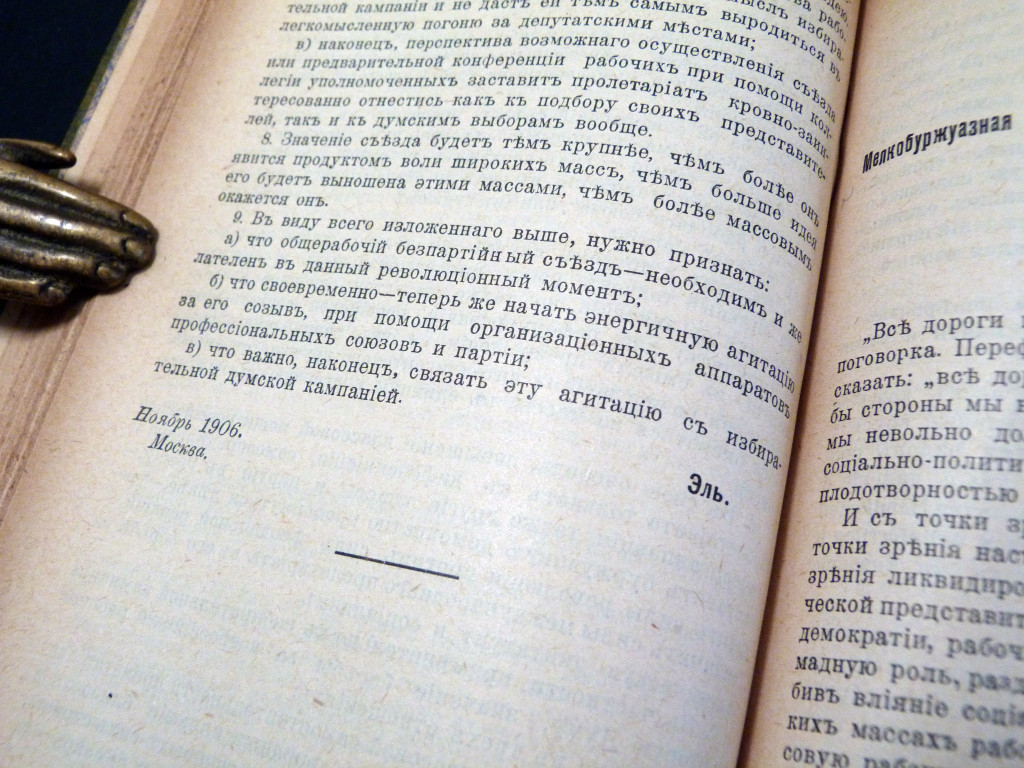
Sammelband: Early 20th Century Russian Revolution literature & politics
1903–1907, including Mensheviks, Worker's Poetry, and von Suttner's Lay Down Your Arms! A very rare collection of five works.
Author
Publisher
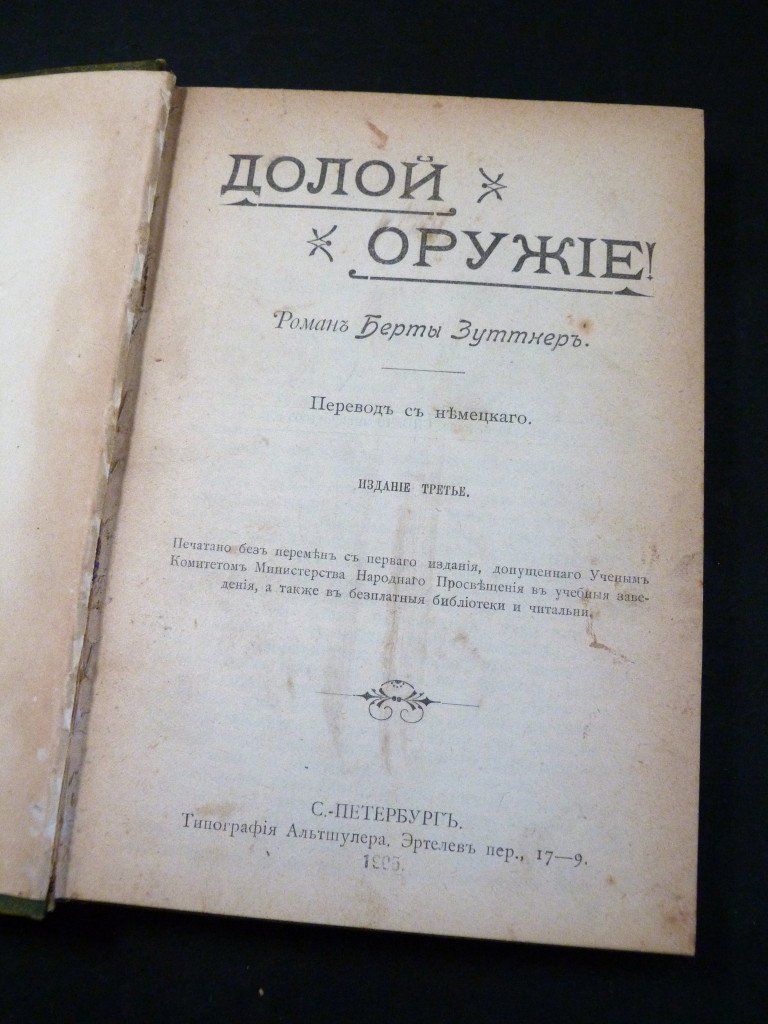

Printing Details
This is a collection of five scarce Russian language pieces, spanning some of the most volatile years of the early twentieth century Russian history (1903–1907), and consisting of fiction, worker poetry and important political papers. Russian text.
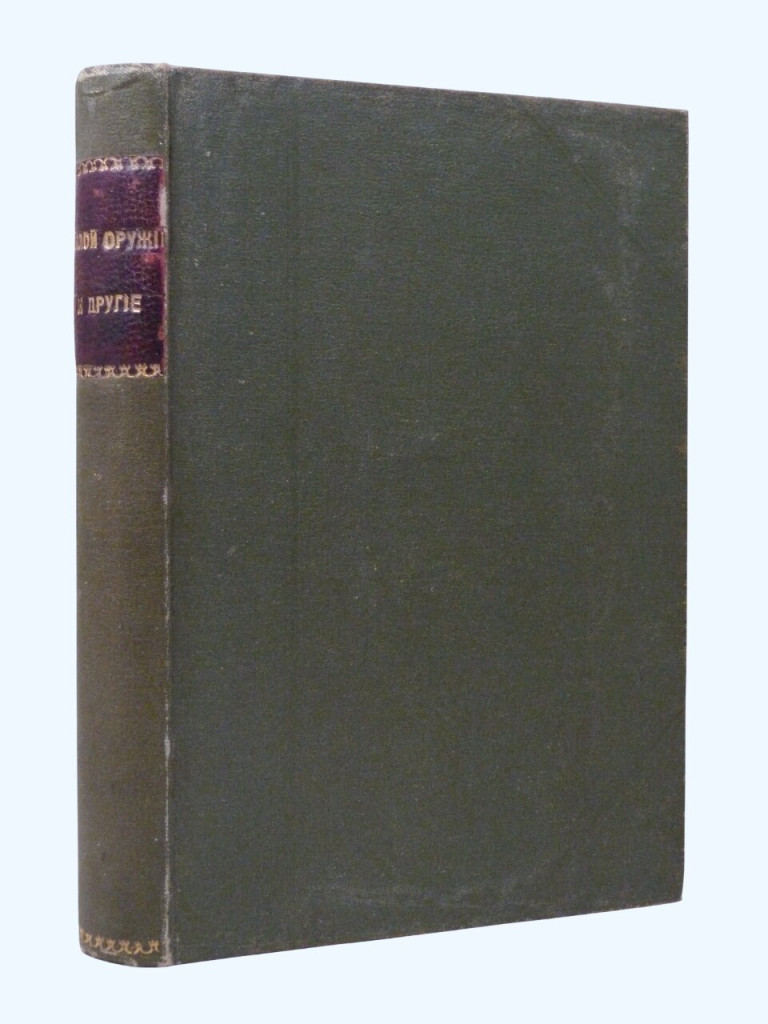
The works are bound in green cloth with red leather title label to spine which reads "Lay Down Your Arms! and others". All text is in Russian. The book measures 19 × 13cm, and some contents have had the margins trimmed to fit the binding but without loss. Pagination below.
The contents are:
1. Lay Down Your Arms! by Bertha von Suttner, published by Altshuler, St Petersburg, 1905. Third Russian edition, 93pp. Von Suttner's classic anti-war novel first published in Germany in 1889 as Die Waffen nieder! An interesting edition as published in the same year that von Suttner was awarded the Nobel Peace Prize, with this issue stating the text had been "approved by the Scientific Committee of the Ministry for Public Education". The text is complete and in strong readable condition.
2. On the All-Russian Workers' Congress, published by Provincial Colleague (Sotrudnik provintsii), Moscow in 1907, and containing a collection of articles (sbornik) from the Russian Social Democratic Labour Party (the R.S.D.R.P.). An important piece in this sammelband as it is a rare survival. The contents in this are : (i) Aleksandr Arkhangelsky, The Significance of Non-Partisan Workers' Congresses (in France and Germany), (End of November 1906), pp3–47, analysing workers' congresses in Western Europe, arguing that this strengthens their Socialism. Good readable condition but with a small hole (1.5 × 1cm) to the centre of the page, possibly a production error as the angle of text is skewiff. (ii) El (pseudonym of L S Yezhov / Ezhov, born L S Tsederbaum, brother of Julius Martov and Lydia Day, both prominent Mensheviks), The All-Russian Workers' Congress (November 1906), pp49–88. A key part of the Mensheviks' ideology of a broader, democratic, and legalistic party, as opposed to the Bolsheviks' centralized, exclusive party of professional revolutionaries committed to immediate, violent socialist revolution. Lazar Solomonovich Yezhov (1874–1940) was a prominent Menshevik, and key proponent of the "Workers' Congress", his work here explores the connection between the Workers' Congress and the objective conditions of the class struggle in in Russia. He is known to have used El as a pseudonym to avoid arrest (as per the Russian National Library) and was frequently attacked by Lenin in his writings as a Menshevik Liquidator. (iii) Akhmet Ts-ov (Akhmed Tsalikov), Petty-Bourgeois Elements in the S-D Party and the Workers' Congress (October 1906), pp89–118. A warning that the party is being swamped by petty-bourgeois elements, and the need for a non-party congress to cleanse the movement of outside influences. (iv) The three main sections are followed by a five-point summary of Menshevik Resolutions (pp119–122), an editorial note (pp123–125), a one page list of brochures and articles focusing on the Workers' Congress, and serves as a bibliographical who's who in the Menshevik intellectual circle of the time, a contents page, and an advertisement for Yuri Larin's A Broad Labour Party and a Labour Congress to be published by Novyy Mir (New World) in St Petersburg and Moscow.
3. Songs of Working Life by Fedor Postupaev, published by Donskaya Rech (The Don Speech), Rostov-on-Don, 1904 (approved by the censor, May 7 1904). 47pp. A collection of 'proletarian poetry' describing both rural peasant life (by the land) to the harsh industrial life in the city (by the cauldron). This was quite a bold move to publish in 1904, a year before the first Revolution. Donskaya Rech was frequently raided by the authorities and their books confiscated or burned as they were seen as inciting worker unrest in Tsarist Russia. The author was a self-taught poet, he held views seen as radical including the immediate confiscation of land from the exploiters and its fair, equal division. This is believed to be his first published book.
4. Songs of Labour, published by Donskaya Rech (The Don Speech), Rostov-on-Don, 1903 (approved by the censor, December 4, 1903). 48pp. An anthology containing poems and songs such as It is Dawning, Comrade by Innokenty Omulevsy, Dubinushka (The Little Cudgel) by Leonid Trefolev, Ivan Bunin's Worker's Songs, Konstantin Blamont's The Blacksmith, and Song of the Ploughman by Aleksey Koltsov, as well as translations of Longfellow, Thomas Hood, and Freiligrath
5. A Short History of the French People by Paul Lacombe, published by Donskaya Rech (The Don Speech), Rostov-on-Don, 1904 (approved by the censor, October 4, 1903). 138pp. A Russian translation of Lacombe's 1878 French title, of interest as the French revolution was seen as a blueprint for Russian revolutionaries. The pagination is a little out of order, with pp105–120 is bound between p88 and p89.
Condition
Good condition for age and considering the item's history. The green cloth is in good condition. Some light patches of fading and minor rubbing. Each piece is bound without the covers but retain the original title page and publishing details. The pages are tanned throughout, mostly marginal, and some pages have been trimmed for binding. As mentioned there is one page with a small hole that looks like a production fault, and some pagination out of order in the Lacombe's History but all pages present. The book remains in good readable condition, and a rarely offered collection of primary source Russian Revolution material and literature.
Further images available on request.
Books are currently zero-rated for duty (as of January 2026), so the price shown is the price you pay.